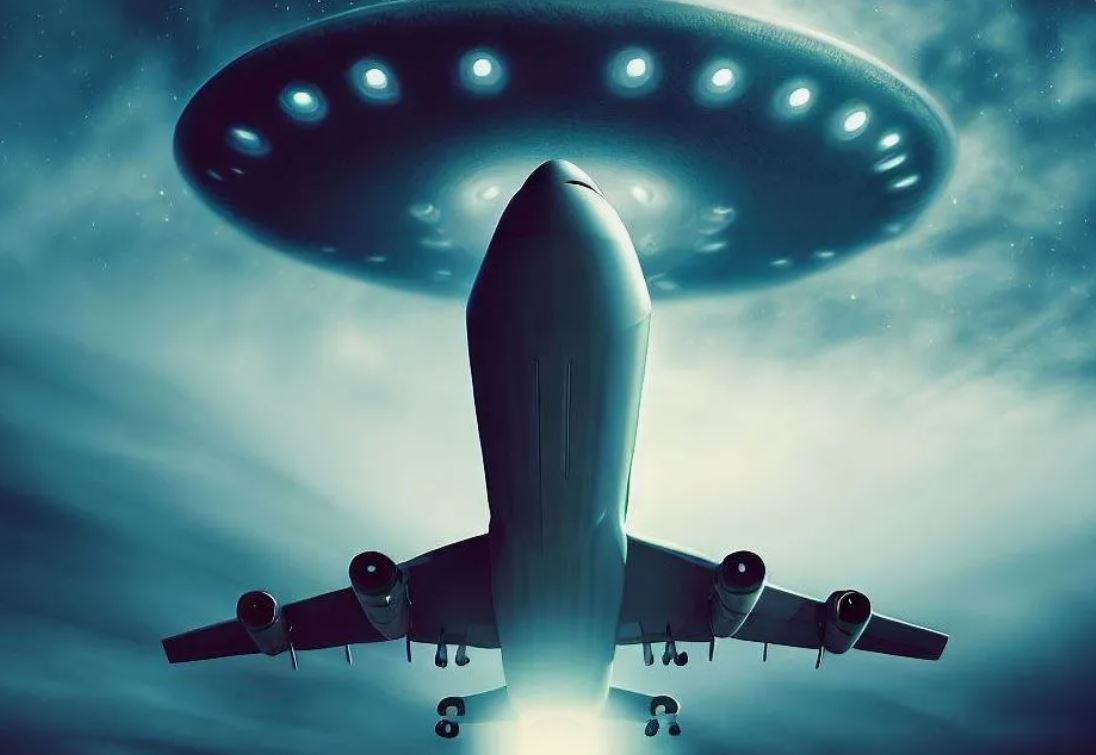
JAPAN AIRLINES CARGO FLIGHT 1628 AND A UFO ENCOUNTER
The incident occurred in November 1986. It was destined to remain one of those covered-up incidents, but when the pilot insisted on revealing what he had seen—even at the risk of his career—the world learned of this event. Our hero is Kenju Terauchi, a former fighter pilot with over 10,000 hours of flight experience.
Now put yourself in the shoes of pilot Kenju Terauchi and listen to what happened on November 17, 1986.
A shipment of wine was to be transported from Paris to Tokyo. Experienced Captain Kenju Terauchi took command of the Japan Airlines 747 cargo flight. According to the plan, Flight 1628 was scheduled to first fly to Reykjavik, Iceland, then cross the North Atlantic and Greenland to pass over Canada, continue to Anchorage, Alaska, and finally cross the Pacific Ocean to arrive in Tokyo. The crew consisted of Captain Kenju Terauchi, First Officer Takanori Tamefuji, and Flight Engineer Yoshio Tsukuba.
On November 16, 1986, the wine-laden JAL Flight 1628 took off from Paris and flew to Reykjavik, the first leg of the journey. The next day, they continued their journey, flying over Greenland and then smoothly crossing northern Canada.
Shortly after crossing the Alaska border, at 5:09 p.m. local time, Anchorage Air Traffic Control made radio contact with them and reported the first radar contact. The Anchorage air traffic controller instructed JAL1628 to turn 15 degrees left and head toward a point known as Talkeetna on a 215-degree course, and provided the transponder codes. The Boeing 747 was at an altitude of 35,000 feet and was traveling at a ground speed of approximately 600 miles per hour.
In response, the first officer initiated a left turn of approximately 15 degrees. Captain Terauchi, seated on the left side of the cockpit, noticed unidentified lights about 2,000 feet below and to the left of the aircraft around 5:11 p.m. Initially, assuming they were military aircraft, he did not pay them much attention. This was because the nearby Eielson or Elmendorf Air Force Bases were in the area, and military aircraft were known to patrol Alaskan airspace. However, he soon realized that the lights were moving at the same speed as his own aircraft. This was not a typical occurrence for jets.
Terauchi quickly asked the Anchorage Control Center twice to find out if there were any other aircraft in the area. The Control Center confirmed that there were no military aircraft and reported that the ground radar had detected only Flight 1628. Then, the two lights began to move erratically. At this point, Captain Terauchi believed they were UFOs. The lights were flickering in a manner resembling an irregular heartbeat.
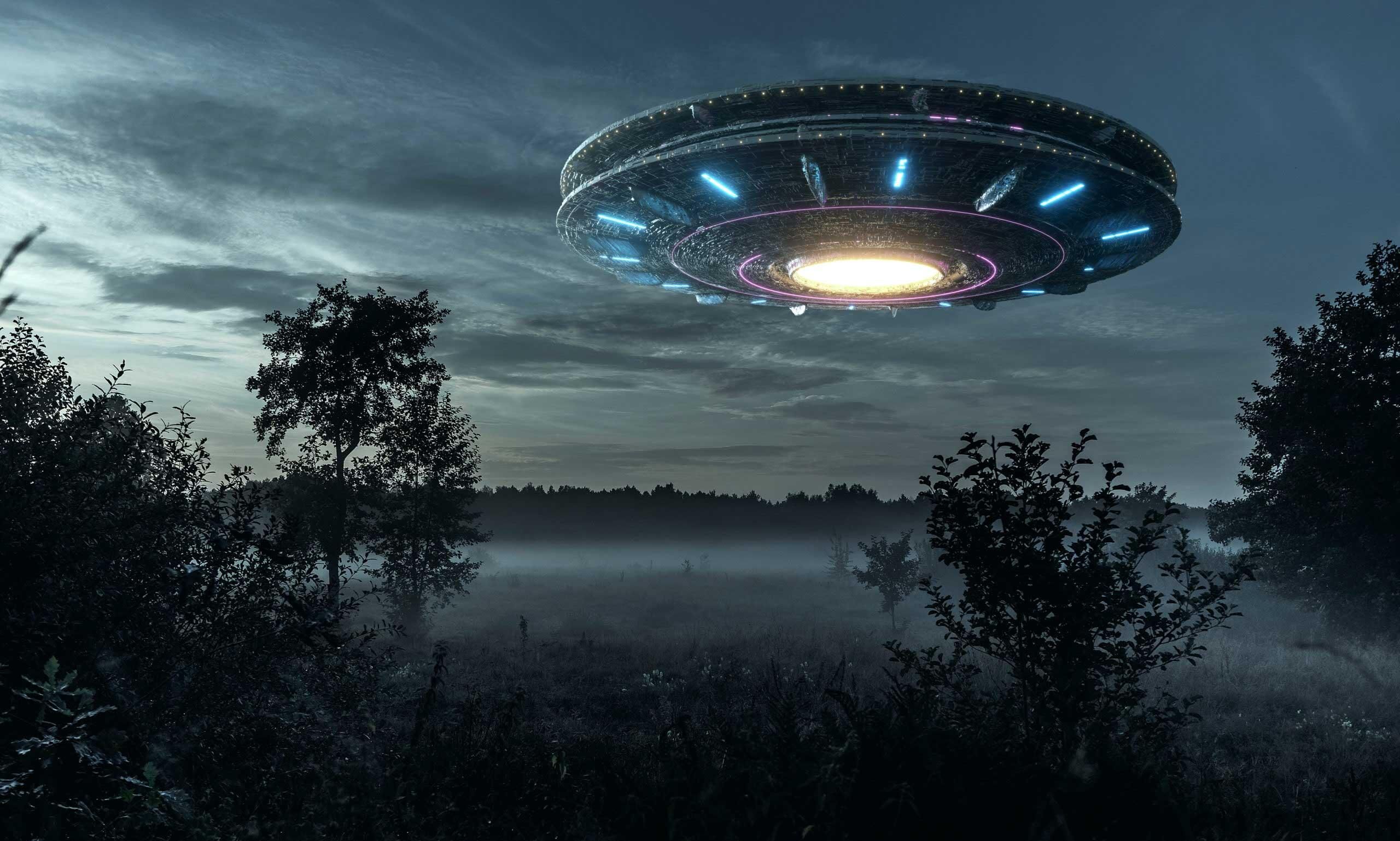
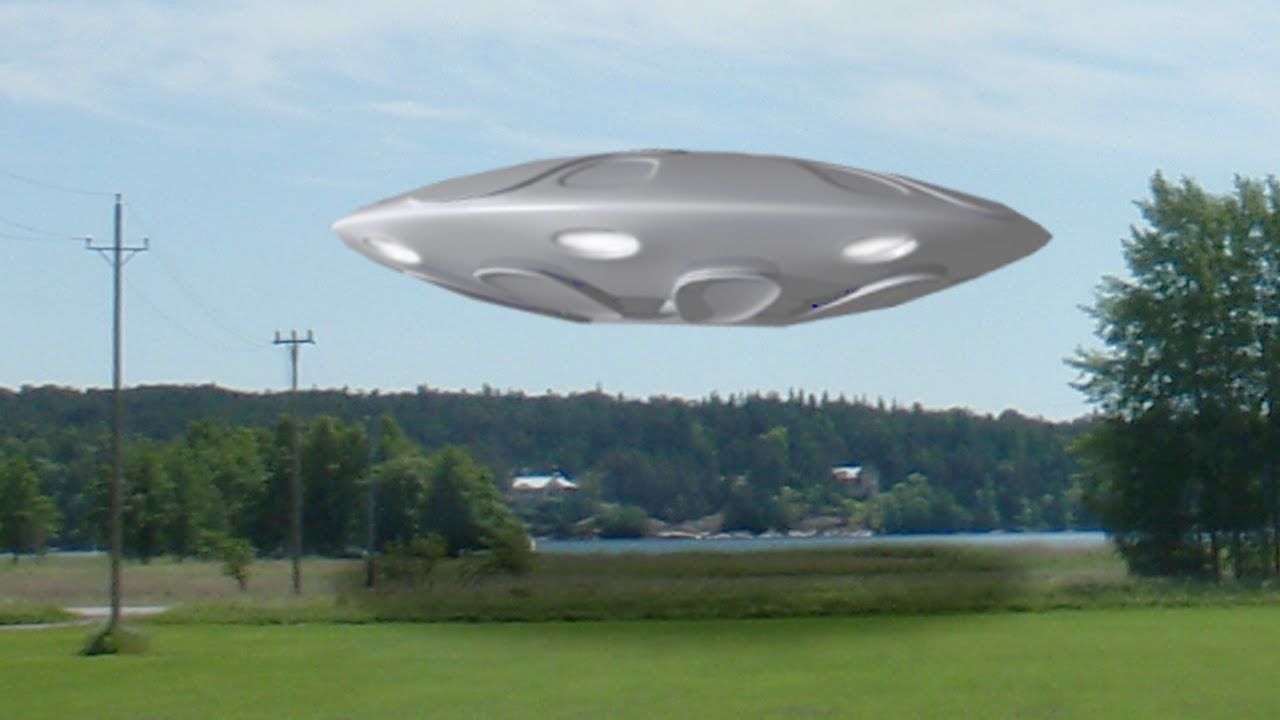
About seven minutes after they began tracking the lights, at the most unexpected moment, two spacecraft came to a stop right in front of them and began emitting light. The cockpit was brightly illuminated, and they felt a warmth on their faces.
Shortly afterward, the fiery light faded, transforming into small rings of light flying alongside them at the same speed. From the center of the ships, intermittent bursts of light resembling a flickering flame were emanating. Their size resembled that of a large airplane; they were flying slightly higher and directly in front of them.
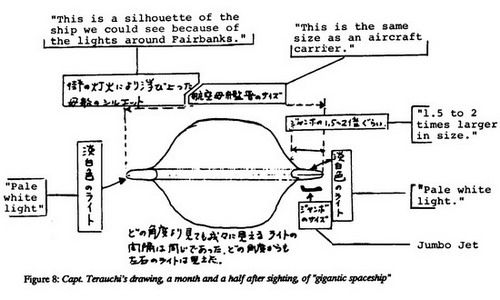
Given the impossibility of man-made machines suddenly appearing and maintaining the same formation as a fast-moving aircraft, the inexplicable nature of such an encounter puzzled Captain Terauchi. Still, there was no sense of immediate threat, only bewilderment. The reasons behind their being so close remained a mystery.
A faint, white light marked the path the ships had taken and was moving at the same speed as the plane. Despite inquiries made to Anchorage Central, no object was detected on their radars. However, the plane’s air radar revealed a significant green circle approximately seven or eight miles away in the same direction.
As they flew over Eielson Air Force Base and Fairbanks, the city lights illuminated the terrain below. Suddenly, Terauchi came face-to-face with the silhouette of a massive spacecraft.
In coordination with Anchorage Center, Captain Terauchi performed evasive maneuvers, including circling and changing altitude. However, the massive UFO—which Terauchi described as being the size of two aircraft carriers—continued to follow Flight 1628 despite all his efforts.
Terauchi was terrified and worried about what the UFOs were trying to do. Anchorage Center suggested dispatching a military jet, but Captain Terauchi refused, concerned about the potential unintended consequences of a military encounter with the unidentified craft. Around the same time, a United Airlines passenger plane entered the airspace and was instructed by air traffic control (ATC) to visually observe the situation. Terauchi said, “When the United plane approached our position, the spacecraft suddenly vanished. This strange encounter ended about 150 miles from Anchorage.”
Investigation into Flight 1628
In 1986, John Callahan, who was serving as FAA Division Chief at the Accident and Investigation Branch in Washington, D.C., received an urgent call from Alaska approximately one week after the JAL 1628 incident.
In an interview conducted around the year 2000, Callahan recounted the incident, stating that an unidentified caller—whose identity he could not recall—conveyed a sense of urgency regarding the media inquiries flooding the FAA office in Alaska. The caller mentioned to Callahan an UFO sighting involving a 747 aircraft that had occurred a week earlier.
Callahan instructed the caller to gather all available data—including civilian and military records—and all accessible tapes, and have them sent to the technical center where he was stationed overnight. Despite the military’s initial reluctance to share the tapes, the caller managed to gather all available information from Anchorage Air Traffic Control.
Callahan also explained that, in order to fully understand the situation, they had instructed the caller to precisely reconstruct the situation in Anchorage so that all collected data—including radar, digital radar, and audio recordings—could be displayed on the radar monitor.
After reviewing the tapes, Callahan listened to a three-way conversation involving Anchorage Air Traffic Control (ATC), Elmendorf’s NORAD Regional Operations Control Center (ROCC), and Captain Terauchi of JAL Flight 1628. He also examined a tape showing ATC radar observations on a screen. Although Anchorage Air Traffic Control had not detected UFOs on their radars, it was clear from the conversations that the military was actively tracking the UFOs. Callahan explained:
“Military controllers have not only long-range and short-range radars but also a radar they call an ‘altitude detection radar.’ So, if they can’t detect an object on one system, they might catch it on another. However, our radar system did not record such an observation.”
The details provided by the military controller revealed that the UFOs were traveling at incredibly high speeds in the airspace around the 747. Additionally, the military controller made another surprising observation: toward the end of the incident, a United Airlines plane was diverted from its route to observe the JAL aircraft. Interestingly, Captain Terauchi could no longer see the large UFO at that point, nor could the United Airlines pilot. However, without either pilot’s knowledge, military radar clearly showed that the UFO had hidden behind the United aircraft and begun to follow it.
After the presentation, Callahan’s superior instructed him, “Do not communicate with anyone until I give permission.” The next day, his superior held a briefing; Callahan described it as follows: “I gathered all the personnel at the technical center. We gathered on the upper floor, equipped with various data boxes and printouts filling the room. Three people from the FBI, three from the CIA, and three from Reagan’s scientific research team were brought in; there were others whose identities I didn’t know, but they all seemed excited.”
Callahan and his team presented all their findings to the group and answered countless technical questions.
At the end of the briefing, those present were made to take an oath of secrecy and were instructed to deny the existence of the meeting and its records. This instruction came from a CIA representative. Stunned by this directive, Callahan questioned the logic behind keeping such information classified. If the observed object was not the Stealth Bomber being developed at the time, he reasoned it could only be classified as a UFO. He questioned why the public should not be informed. The CIA representative explained that disclosing such information to the American public would likely cause widespread panic, which is why the decision was made to keep it secret. Despite this, Callahan kept copies of all the data in his office.
When asked for his opinion, Callahan stated that he believed what they had witnessed looked like a UFO. He noted that Ronald Reagan’s scientific team shared his excitement regarding the data and emphasized that this was the first instance of a UFO being recorded on radar for an extended period.
Following the incident, Captain Terauchi was reportedly reassigned to a desk job a few months later due to the company’s embarrassment, but was later reinstated to his position. Callahan, meanwhile, retired from the FAA, continued his career as an industry consultant, and occasionally shared the true story of Flight JAL 1628.
Meanwhile, you can access Captain Kenju Terauchi’s official statement via the link below.
http://ufoevidence.org/Cases/CaseSubarticle.asp?ID=289
Yes, although it dates from the recent past, we’ve examined yet another UFO file buried deep in our history. Yes, we know—space travel isn’t something that can be done easily. Exceeding the speed of light, using the fabric of spacetime via wormholes to reach different points in the universe (if possible), and even thinking that aliens might not be able to do this—these are the things our common sense tells us not to consider. After all, the nearest star system, Proxima Centauri, is 4.24 light-years away from us. Is it possible for aliens from that system’s planets to travel at the speed of light and spend 4.24 years doing so? Or perhaps longer periods at slower speeds. What if their lifespans, compared to ours, stretch to a thousand years—or even longer…
The sea of questions is endless. What do you think—could there be another explanation for these phenomena we can’t explain?
Levent Aslan.
Sources:
https://www.paranormalcatalog.net/ufos/flight-1628-aircraft-manoeuvres-to-avoid-ufo
https://web.archive.org/web/20110629205844/http://ufoevidence.org/Cases/CaseSubarticle.asp?ID=289
https://web.archive.org/web/20110629160228/http://ufoevidence.org/cases/case287.htm
In order to have a signed physical copy of this book, you can make a payment notification after making the payment to the bank information below









Add Comment